
Oscoda County Projected Release Dates
A projected date is calculated from the record as it stands now. An actual release date records what happened after all orders, sentence calculations, holds, and physical processing were complete. Michigan's public MDOC fields use the terms Earliest Release Date and Maximum Discharge. Neither should be renamed “scheduled release” without support from the person's official record.
For an ordinary indeterminate state-prison sentence, the earliest date marks the point when the Parole Board can obtain jurisdiction after the minimum is served. The Board can grant, deny, or defer parole. The maximum date is the sentence endpoint under MDOC authority, but another sentence, warrant, detainer, or court order can keep the person in custody elsewhere.
- Earliest Release Date
- The first parole-eligibility point MDOC displays for the applicable sentence calculation.
- Maximum Discharge
- The maximum-term endpoint shown by MDOC for the sentence record.
- Detainer
- A notice that another authority may seek custody when the current confinement ends.
- Jail credit
- Time the judgment recognizes toward the sentence calculation.
Classify Oscoda County Custody
Oscoda County has no conventional county jail. Its sheriff uses a temporary holding cell, and many longer local detentions are housed at Roscommon County Jail under the current intercounty agreement. That means the place of arrest is not enough to identify the office that computed the date.
| Custody Type | Date Source | What the Date Means |
|---|---|---|
| Pretrial Oscoda case | Court bond or release order and physical custodian | No fixed sentence-release date exists before disposition |
| Oscoda county-jail sentence | Judgment, Roscommon jail computation, and Oscoda court record | Calculated sentence end with lawful jail credit and eligible good time |
| Michigan state prisoner | MDOC OTIS and judgment | Earliest Release Date and Maximum Discharge, not a promise |
| Federal prisoner | BOP locator and federal sentence record | Federal projected or actual date only |
A name dropping from Roscommon JailTracker does not answer the date question. The person may have been released to the community or transferred into another system. Ask for the exact exit disposition.
Find an Oscoda County Release Date
Begin with the authority that currently holds the person. Use an MDOC number when state prison is involved. For local custody, gather the full legal name, date of birth, Oscoda case number, and approximate booking date so Roscommon and Oscoda staff can locate the correct records.
- Confirm whether the person is at the Oscoda holding cell, Roscommon County Jail, MDOC, or another authority.
- For MDOC custody, open OTIS and search by MDOC number or name.
- Match the record using identity details, conviction county, offenses, and status.
- Read Earliest Release Date and Maximum Discharge alongside the active sentences and current status.
- For a local sentence, obtain the Oscoda judgment and ask Roscommon for its physical-jail release computation.
- Ask about holds, detainers, consecutive sentences, amendments, or parole action that can change the path.
- After release, obtain the custodian's release date, time, and disposition rather than relying on the old projection.
The Oscoda County release-record search shows how to reconcile the sheriff, Roscommon jail, and court portions when documentary proof is needed.
Note: A present jail-roster match proves current listed custody, while an absent match must be confirmed by the physical custodian.
Oscoda County OTIS Date Fields
OTIS covers MDOC prisoners, parolees, probationers, and people discharged within the preceding three years. It does not cover county-jail-only sentences. Search inputs include name, MDOC number, sex, race, age, status, and marks, scars, or tattoos. The MDOC number is the most precise key because OTIS ignores other criteria when that number is entered.
A profile can show current status, assigned location, Earliest Release Date, Maximum Discharge or actual Discharge Date, sentence terms, offense, court file, sentence date, conviction county, aliases, and supervision information. Read the active and inactive sentences together. A discharged profile can remain visible for three years, while an older one may fall outside OTIS even though the court record still exists.
The official OTIS launch page explains the system's scope and cautions.
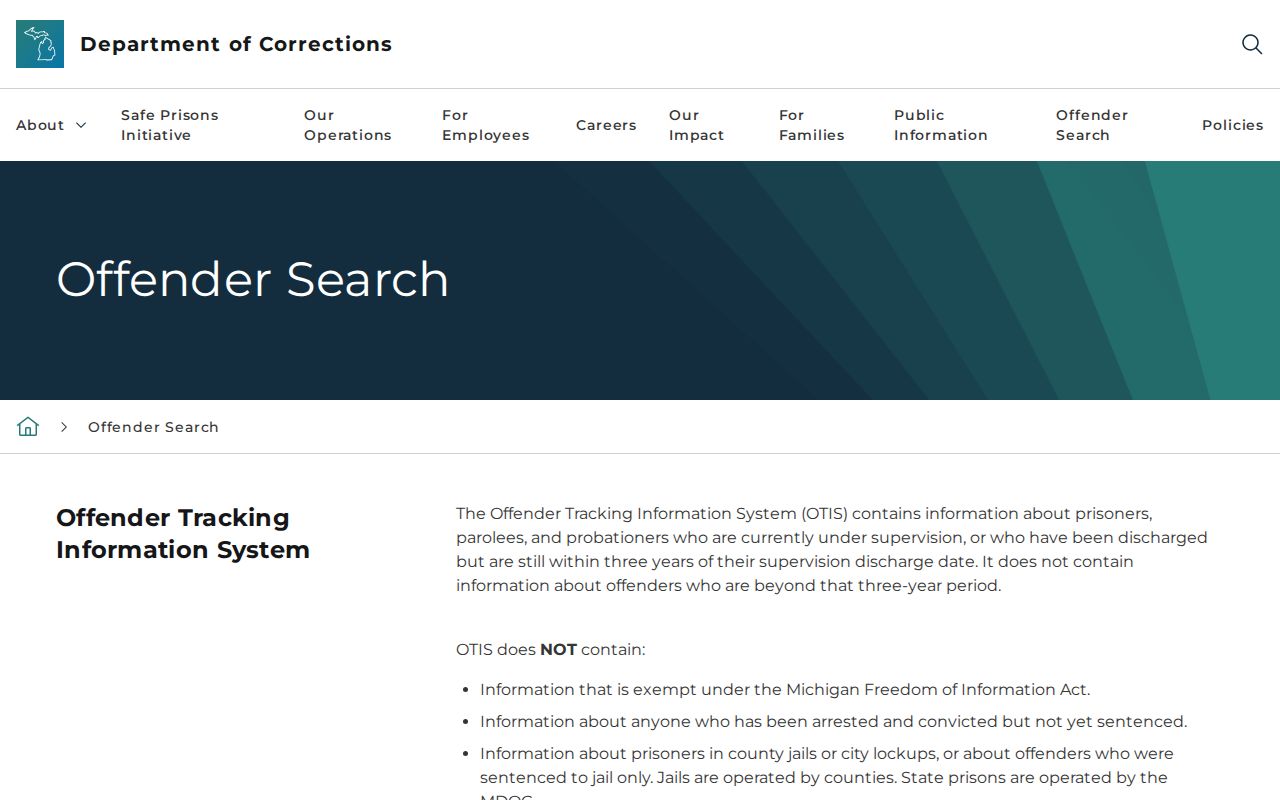
This view leads to the state search whose sentence fields distinguish parole eligibility from final discharge.
Michigan Prison Release Calculations
Michigan does not use a simple universal “serve 85 percent” formula for an ordinary modern MDOC sentence. The truth-in-sentencing framework generally requires service of the judicially imposed minimum in prison before parole consideration. Disciplinary time can delay eligibility for covered offenses. MDOC calculates the date from the judgment and the law applicable to that sentence.
MCL 791.234 governs Parole Board jurisdiction and eligibility across several sentence categories. Life sentences, specified offenses, consecutive terms, historical credit systems, and special categories require their own reading. The ordinary minimum-term explanation should never be applied to every case.
Historical Michigan sentences may involve good time, disciplinary credit, or another statutory regime. Offense date, conviction statute, sentence type, and sentence structure matter. The official MDOC calculation and judgment are safer than counting days from a news report or an online calculator.
The MDOC prisoner release date FAQ explains the state's minimum and maximum sentence fields.
This official explanation supports reading the earliest date as a parole-eligibility point rather than a guaranteed release appointment.
Oscoda County Jail Good Time
Oscoda County jail sentences follow a different framework from MDOC prison sentences. For an eligible county-jail sentence, MCL 51.282 allows one day of reduction for each six days of sentence when the prisoner's record shows no jail-rule violations. The statute also provides for forfeiture authority. MCL 51.283 addresses jail rules and notice of the allowance.
The local calculation is unusual because an Oscoda sentence may be served under an out-of-county physical custodian. Obtain Roscommon County Jail's calculation for the time it housed the person, and obtain the Oscoda judgment and later court orders. Do not assume which sheriff's record has every component.
No official Oscoda or Roscommon weekend-release convention, automatic Friday-release practice, or fixed daily exit time was found. Call Roscommon before travel and ask Oscoda whether transport or a separate local action occurred.
Note: County-jail good time and MDOC truth-in-sentencing are separate rules and should never be blended into one percentage.
Who Computes Oscoda Release Dates?
For a local Oscoda sentence, the answer can span three records. The Oscoda court judgment supplies the sentence and court-awarded jail credit. Roscommon, as physical custodian, records the confinement and the jail calculation. Oscoda may retain arrest, holding, and transport timestamps. Each answers a different part of “when do they get out.”
Ask Roscommon for the existing release computation and actual exit record. Ask the Oscoda court clerk for the judgment, sentence amendments, and register of actions. If the person was only held before trial, ask for the bond or release order instead of a sentence projection. Agencies need not create a new calculation that is not already kept, but they can provide existing records subject to access law.
This out-of-county custody arrangement is why a broad statewide rule cannot yield a reliable local exit time. The official papers must be reconciled.
Why Oscoda Release Dates Change
A projected release date reflects the known record. Later information can move the date or prevent community release at the expected time. The reason should appear in an updated computation, court order, custody record, or parole action rather than being guessed.
| Factor | Possible Effect |
|---|---|
| Corrected jail credit | Changes the credited time used in the calculation |
| Amended judgment | Changes a court-controlled sentence term or instruction |
| Consecutive sentence | Requires another term to follow before release |
| Jail-rule violation | Can affect eligible county-jail good time under the statute |
| Parole decision or rescission | Can permit, delay, or stop a planned prison release |
| Warrant, hold, or detainer | Can lead to pickup or transfer by another authority |
| Transfer | Ends one custodian's record while custody continues elsewhere |
OTIS cautions that data may not always be complete or current. When the date has legal or travel significance, verify it with the custodian close to the expected release.
Oscoda County Parole Timing
Reaching an Earliest Release Date does not force a prison release. The Michigan Parole Board can consider the case once it has jurisdiction, but eligibility and approval are distinct. A favorable decision can still require placement work, conditions, and final release coordination. New adverse information or conduct can suspend or rescind a decision.
For one person, use OTIS with the official parole notice or order. Michigan does not publish a name-searchable database containing every individual parole decision. The public clemency hearing calendar is not a calendar of all routine parole interviews.
Parole also differs from discharge. The person leaves prison but remains under MDOC sentence and supervision. Maximum discharge or a later formal discharge ends MDOC authority over that sentence, subject to any separate case or hold.
Confirm Oscoda County Release
As the projected date approaches, verify the current status with the physical custodian. For Roscommon County Jail, call 989-275-9070. For the Oscoda temporary holding or transport trail, call the sheriff at 989-826-3214. For MDOC custody, recheck OTIS and the appropriate corrections contact.
Registering through the Oscoda County VINE inmate check can provide a custody-change alert while the person remains listed. The alert must still be read carefully. “Transferred” is continued custody, and “released” should be confirmed with the named agency when destination or exact time matters.
Pretrial cases require a different kind of date check. A bond amount or release condition does not prove that the person has completed processing and left. Search the Oscoda court docket for the order, then ask the physical custodian whether the conditions were met and when the exit occurred. A later court date is not a projected jail release date.
If the expected date passes without a release, ask whether an amended judgment, hold, warrant, transport delay, or receiving agency changed the path. Staff should identify the record that controls the answer. A family estimate based only on sentence length cannot account for each of those events.
The actual release record should state the exit date and time plus the disposition or receiving agency. That record resolves what the earlier projection could not: whether, when, and how the person actually left the custodian.
Keep the projection and final record as separate documents. Comparing them shows whether the expected date held, changed, or became a transfer date instead of a community release.
Record the date of each check.