
Oscoda County Parole or Probation
Parole and probation can both place a person under Michigan Department of Corrections Field Operations Administration supervision, but they begin in different ways. Parole is permission to leave state prison while the sentence continues. Michigan law does not treat parole as the end of the sentence. Probation comes from a court order and can be imposed without a state-prison term or a recent jail stay.
The distinction matters in Oscoda County. A name leaving Roscommon County Jail's live roster does not establish either status. The person could have posted bond, finished a county sentence, been transferred, entered probation, or moved into MDOC custody. The correct record depends on the event.
| Feature | Parole | Probation |
|---|---|---|
| How it starts | Release from state prison by MDOC authority | Order entered by the sentencing court |
| Legal status | The prison sentence continues outside prison | The person follows court-ordered supervision terms |
| First public check | OTIS status and supervision details | OTIS plus the Oscoda court docket |
| How it ends | Parole discharge or maximum discharge | Court or MDOC-recorded probation discharge |
- Parole
- Conditional release from state prison while the sentence remains in force.
- Probation
- Court-ordered community supervision that may occur without a prison release.
- Discharge
- The formal end of the supervision authority shown in the controlling record.
- Absconder
- A person alleged to have stopped required contact or left the required supervision area.
Check Oscoda County Post-Release Supervision
The strongest public starting point is Michigan's Offender Tracking Information System, commonly called OTIS. It covers MDOC prisoners, parolees, probationers, and people discharged within the prior three years. It does not cover a person whose only custody was a county jail or city lockup. An absent result can reflect system scope, a spelling issue, or an older discharge. It is not proof that supervision never existed.
- Search by MDOC number when it is known. That number identifies one correctional record and overrides other search fields.
- Otherwise enter the last name and first name. Compare aliases, birth data, conviction county, offense, and status before choosing a result.
- Read the status literally. Select Parolees, Probationers, Discharged, or All based on the question being asked.
- Check the supervision location and dates. A displayed office may be the last assigned location rather than the person's current whereabouts.
- Call the Oscoda County parole and probation office with the MDOC number to confirm public office and status details.
- For probation, review the Oscoda court docket and obtain the probation order or discharge from the clerk when the exact authority matters.
The official OTIS field guide explains its status codes. `PAROLE` means release from prison under supervision. `PROB` means circuit-court probation supervised by MDOC field operations. `DISCHRG` can reflect completion, maximum discharge, or death, so the surrounding record must be read before describing the outcome.
For a broader release-record reconciliation, the Oscoda County released-inmate search explains how Oscoda arrest, Roscommon jail, and court records fit together.
Note: OTIS keeps a discharged supervision record online for three years, which is a system window rather than proof of expungement.
Oscoda County Supervision Office
Oscoda County is assigned to MDOC Outstate Region 3. The state directory lists a local parole and probation office in Mio. It is the practical follow-up when OTIS shows the person under supervision but the public profile does not resolve the assigned office or current public status. Provide the MDOC number if possible. Exact residence, treatment, reporting times, and other protected details should not be expected.
Oscoda County Parole/Probation311 Morenci
P.O. Box 835
Mio, MI 48647
989-826-9186
The address is reproduced as MDOC publishes it. Call before visiting because the directory does not supply local counter hours. The office is a verification route, not a source for a person's daily plans or private supervision information.
The MDOC Region 3 directory shows the Oscoda entry and its contact details.
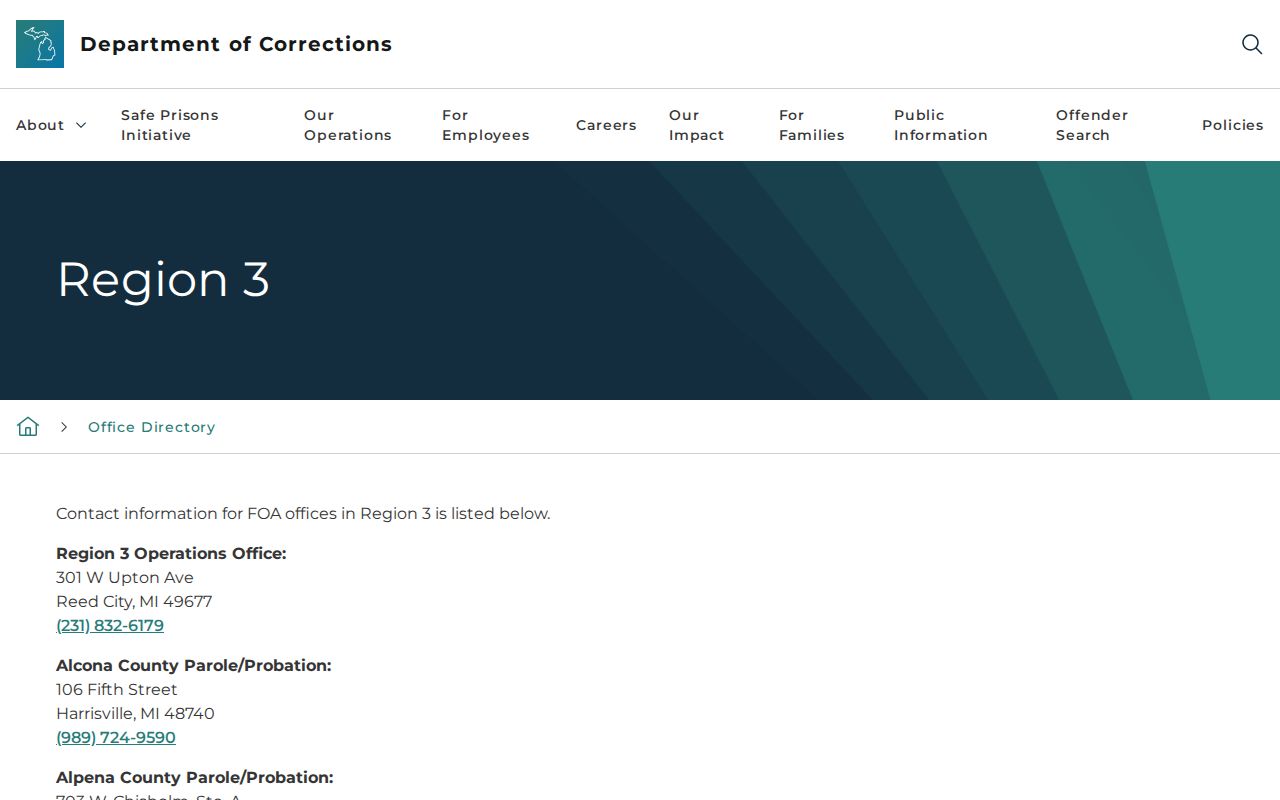
This state directory view helps distinguish the Mio supervision office from a jail, court, or statewide Parole Board contact.
Oscoda County Supervision Channel Sweep
No single local roster answers every post-release supervision question. OTIS is the main statewide lookup. The Mio office can confirm public supervision information. MiCOURT and the local clerk supply the probation order, sentence, later violation entries, or discharge action. VINE serves custody-change notifications, but it is not a full probation history and should not be treated as one.
Oscoda County's contract-jail arrangement adds another limit. Roscommon JailTracker shows current physical jail custody, not whether a person is on parole or probation. If a person disappears from that roster, ask Roscommon whether the exit was community release or transfer. Then use the state and court channels to determine whether supervision followed. A transfer into MDOC is continued custody, even though the county-jail entry ends.
For an Oscoda probation case, select the correct Oscoda County court in MiCOURT. The 81st District Court handles the preliminary and misdemeanor path, while the 23rd Circuit Court handles felony matters and other cases within its jurisdiction. A docket entry may identify the sentence, probation order, alleged violation, or later discharge, but the web display does not replace the signed court record. Ask the clerk for the order when its precise terms or effective date matter.
VINE fills a narrower role. It can send a custody-change alert while a participating custodian supplies the event, which can help when an Oscoda arrest is housed in Roscommon. It does not show the full course of community supervision. A VINE release alert, an OTIS parole status, and a probation order answer three distinct questions and should not be merged.
Oscoda County Absconder Status
An absconder label describes an alleged supervision failure. It is not a new conviction by itself. OTIS distinguishes `ABSCOND1`, a parole absconder actively sought by MDOC, from `ABSCOND2`, a probation absconder under the sentencing county's jurisdiction. A location on an absconder profile is the last supervision location, not proof of where the person is now.
No official Oscoda County absconder or warrant list was verified. Use the OTIS status, the Mio supervision office, the sentencing court, and official law-enforcement warrant channels. MDOC also maintains a specialized absconder interface and publishes aggregate reports. These are current enforcement resources, not lists of all released people.
Do not approach or attempt to detain a person based on a search result. For an urgent safety threat, call 911. For a possible absconder, follow the reporting instructions supplied by MDOC or law enforcement.
Note: A supervision violation can lead to a warrant or renewed custody, but the official record must show what action actually occurred.
Oscoda County Supervision Conditions
Conditions are the rules attached to parole or probation. Their details come from the parole order, probation order, and assigned agency. Public sources may show a general status or selected supervision conditions, while treatment, reporting, residence, and other personal information may be restricted. The order is more reliable than an assumption based on the offense or release date.
A suspected violation does not automatically prove that supervision was revoked. The responsible agency and court or Parole Board must act. Outcomes can include continued supervision, changed conditions, a warrant, a hearing, or return to custody. Read the latest order and status rather than treating an old docket entry as current.
Oscoda County Parole Authority
The Michigan Parole Board is the sole paroling authority for felony offenders committed to MDOC. Under MCL 791.234, Board jurisdiction generally begins after the minimum term in an ordinary indeterminate sentence, subject to the sentence class and credits that lawfully apply. Eligibility means the Board may consider release. It does not guarantee release.
The public Parole Board pages should not be mistaken for a name-searchable database of every decision. OTIS, the person's notice or order, and MDOC records are the correct individual channels. Public clemency hearing notices concern selected pardon and commutation matters, not a complete calendar of routine parole interviews.
The Michigan Parole Board information page describes the agency's role.
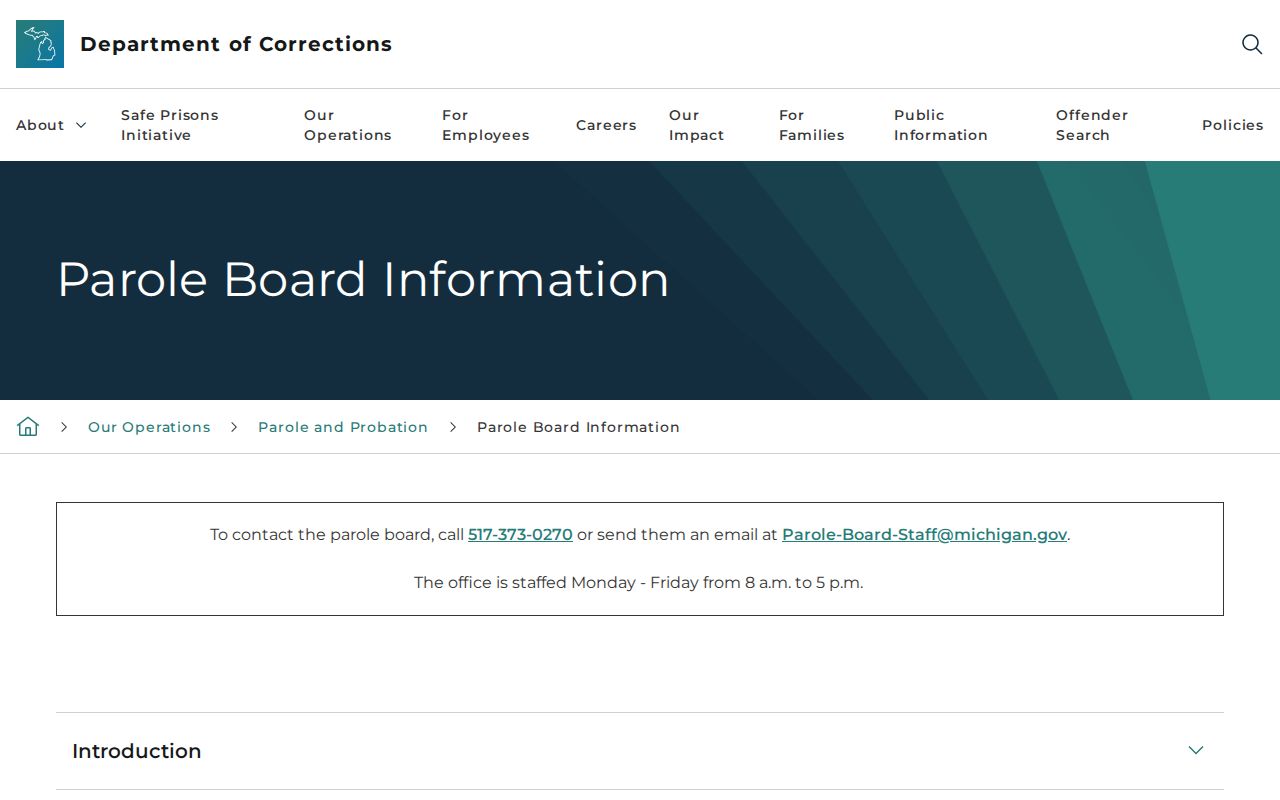
This official page identifies the statewide authority that acts on prison parole, while the Mio office handles local field supervision.
Oscoda County Supervision Discharge
Physical release and final discharge are separate milestones. A parolee has left prison but continues serving the sentence under MDOC authority. A discharged person has reached the formal end of that supervision. Probation ends through the controlling court or MDOC process shown in the official record. The exact end should be established from OTIS, the discharge certificate, or the court order.
OTIS keeps people visible for three years after their most recent supervision discharge. Older records may require the official court file or an MDOC records request. For a paroled or discharged person, MDOC describes records that may include a Basic Information Sheet, judgment, parole material, photograph when available, and a discharge certificate, subject to access limits and redaction.
A blank current search is not a discharge certificate. Match the person, obtain the official end date, and distinguish successful completion from other meanings that an MDOC discharge code can carry.